



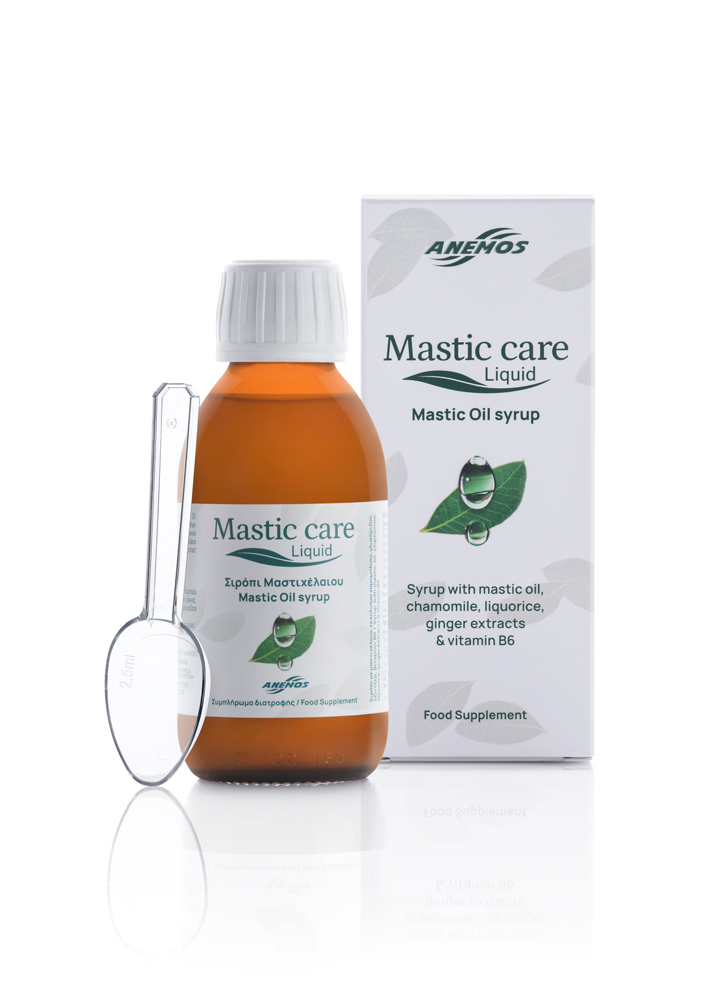
Description
Conseils d’utilisation:
Agiter vigoureusement avant utilisation.
Pour adultes : 1 cuillère doseuse pleine de 5 ml (ou 1 cuillère à café) après un repas.
Agiter avant chaque utilisation permet une répartition homogène des ingrédients actifs et garantit le bon fonctionnement du produit.
Après ouverture, conserver au réfrigérateur pendant 3 mois. Pendant le stockage, une séparation naturelle peut apparaître en surface.
Informations importantes
- Ne pas dépasser la dose journalière recommandée.
- Les compléments alimentaires ne doivent pas être utilisés comme substitut d’un régime alimentaire équilibré.
- Ce produit n’est pas destiné à prévenir, traiter ou guérir une maladie humaine.
- Consultez votre médecin en cas de grossesse, d’allaitement, de prise de médicaments ou de problèmes de santé.
- Tenir hors de portée des jeunes enfants, dans un endroit frais et sec.
Numéro de notification EOF : 120171 / 10-10-2025
Ingrédients
Water, Fructooligosaccharides (FOS), Glycerin, Mastic Oil (Pistacia Lentiscus Chia Gum Oil) 1%, Emulsfier: Lecithin, Stabiliser: Xanthan Gum, Preservative: Potassium Sorbate, Sweetener: Erythritol, Steviol glycosides, Acidity Regulator: Citric Acid, Licorice Extract (Glycyrrhiza Glabra Root), Ginger Extract (Zingiber officinale Rhizome), Chamomile Extract (Matricaria recutita flower), Vitamin B6 (Pyridoxine Hydrochloride).
Sans : sucre, alcool
Ingrédients actifs:
Huile de mastic de Chios:
L’huile de mastic est l’huile essentielle obtenue par distillation de la résine de mastic de Chios, produite à partir de la plante Pistacia lentiscus var. chia. Elle contient plus de 120 substances telles que des triterpènes, des composants volatils et des composés phénoliques. Ces dernières années, un nombre croissant d’études en laboratoire met en évidence diverses activités biologiques de l’huile de mastic, telles que : activité antioxydante, antimicrobienne, anti-inflammatoire, cicatrisante et anticancéreuse. Une étude sur l’huile de mastic indique une protection contre les troubles gastro-intestinaux / l’inconfort gastro-intestinal.4 Suite aux résultats des études en laboratoire, davantage d’études cliniques sont attendues afin de confirmer ces données expérimentales à plus grande échelle. Une étude clinique de 20238 menée sur 192 volontaires sains a montré que l’huile de mastic est sûre et efficace pour réduire le cholestérol total et le LDL après 8 semaines d’utilisation.
Sources:
- Koutsoudaki C, Krsek M, Rodger A. Chemical composition and antibacterial activity of the essential oil and the gum of Pistacia lentiscus chia. J Agric Food Chem. 2005;53(20):7681–7685.
- Darwesh SM, Hashish NE, Zaghloul AM. Study of Chios mastic essential oil: Isolation, chemistry, and wound healing activity. Delta Univ Sci J. 2024;7(1):59–68.
- Kartalis A, Afendoulis D, Didagelos M, Ampeliotis M, Moutafi M, Voutas P, et al. Effects of Chios mastiha essential oil on cholesterol levels of healthy volunteers: A prospective, randomized, placebo-controlled study (MASTIHA-OIL). Hellenic J Cardiol. 2024;77:63–69.
- Spyridopoulou K, Tiptiri-Kourpeti A, Lampri E, Fitsiou E, Vasileiadis S, Vamvakias M, et al. Dietary mastic oil extracted from Pistacia lentiscus chia suppresses tumor growth in experimental colon cancer models. Sci Rep. 2017;7(1):3782.
- Dimas KS, Pantazis P, Ramanujam R. Chios mastic gum: A plant-produced resin exhibiting numerous diverse pharmaceutical and biomedical properties. In Vivo. 2012;26(5):777–786.
- Paraschos S, Magiatis P, Mitakou S, Petraki K, Kalliaropoulos A, Maragkoudakis P, et al. Chemical investigation and antimicrobial properties of mastic oil from Pistacia lentiscus chia. Planta Med. 2007;73(11):1222–1228.
- Bampouli A, Kyriakopoulou K, Papaefstathiou G, Louli V, Aligiannis N, Magiatis P, et al. Evaluation of total antioxidant potential of Pistacia lentiscus chia products. Food Chem. 2015;168:374–381.
- *Heo C, Kim SW, Kim KJ, Kim DW, Kim HJ, Do JH, et al. Protective effects of mastic in non-steroidal anti-inflammatory drug induced gut damage and bacterial translocation in a rat model. Korean J Med. 2006; 71: 354-361.
Fructo-oligosaccharides (FOS)
Les fructo-oligosaccharides (FOS) sont des glucides non digestibles appartenant à la catégorie des fibres alimentaires et, en raison de leur structure chimique, ils ne sont pas dégradés dans la partie supérieure du système digestif. Ils sont naturellement présents dans des aliments d’origine végétale et font partie de l’alimentation quotidienne. Un apport adéquat en fibres alimentaires fait partie d’un régime alimentaire équilibré et varié. « ANEMOS MASTIC CARE LIQUID contient 1000 mg de fructo-oligosaccharides (FOS) par 5 ml. »
La vitamine B6 contribue à :
- le fonctionnement des processus métaboliques visant à produire de l’énergie
- le métabolisme normal des protéines et du glycogène
- le fonctionnement normal du système immunitaire
- la réduction de la fatigue
- la régulation de l’activité hormonale
Fructo-oligosaccharides (FOS) issus de la chicorée :
Ils constituent une source de fibres alimentaires et présentent plusieurs caractéristiques nutritionnelles. Ils agissent comme des prébiotiques qui jouent un rôle dans le maintien d’un environnement intestinal normal. Leur faible indice glycémique, leur faible valeur calorique et l’absorption accrue de minéraux comptent parmi les caractéristiques observées lorsqu’ils sont intégrés dans l’alimentation à une dose appropriée.
Plantes : Gingembre, Camomille et Calendula
ANEMOS MASTIC CARE LIQUID contient des extraits de 4 ingrédients d’origine végétale : gingembre (Zingiber officinale), camomille (Matricaria chamomilla), calendula (Calendula officinalis) et réglisse (Glycyrrhiza glabra), qui sont des espèces végétales traditionnellement utilisées et faisant l’objet d’un intérêt scientifique important.
- Le gingembre (Zingiber officinale) a fait l’objet de nombreuses études concernant sa composition biochimique, comprenant des constituants bioactifs naturels tels que les gingérols et les shogaols. La recherche scientifique s’est concentrée sur ses effets potentiels sur le système gastro-intestinal, le métabolisme, la réponse inflammatoire, ainsi que sur des mécanismes antioxydants et antimicrobiens observés principalement dans des modèles expérimentaux et cliniques.
- La camomille (Matricaria chamomilla) est l’une des plantes aromatiques les plus traditionnellement utilisées en Europe et a fait l’objet de nombreuses études pour ses flavonoïdes et ses huiles essentielles. La littérature scientifique a examiné ses propriétés potentielles liées au système gastro-intestinal, à la réponse inflammatoire légère et à la relaxation des muscles lisses dans des modèles expérimentaux.
- Le calendula (Calendula officinalis) est une plante à fleurs traditionnellement utilisée sous forme d’extraits et d’infusions. Il a également été étudié pour ses composants terpénoïdes et flavonoïdes, les recherches portant principalement sur des applications topiques et sur des modèles liés à la régénération des tissus et à la réponse inflammatoire normale de la peau. Parallèlement, les propriétés antioxydantes potentielles de ses extraits font l’objet d’études.
- La réglisse (Glycyrrhiza glabra) est un ingrédient végétal traditionnellement utilisé dans les aliments et les extraits. Elle contient des composés tels que la glycyrrhizine et des flavonoïdes, qui ont fait l’objet d’études scientifiques.
Bien que les 4 ingrédients d’origine végétale disposent d’une documentation scientifique étendue aux niveaux préclinique et clinique, il est important de noter que, conformément au Règlement (CE) n° 1924/2006 et à l’évaluation de l’EFSA, aucune allégation de santé n’est approuvée pour ces extraits végétaux spécifiques dans l’Union européenne.
Ces plantes sont traditionnellement utilisées dans l’alimentation et dans les pratiques à base de plantes et s’inscrivent dans un cadre plus large d’ingrédients végétaux étudiés pour leur composition chimique et leur activité biologique.
Sources:
- Mao QQ, Xu XY, Cao SY, Gan RY, Corke H, Beta T, et al. Bioactive compounds and bioactivities of ginger (Zingiber officinale Roscoe). Foods. 2019;8(6):185.
- Semwal RB, Semwal DK, Combrinck S, Viljoen A. Gingerols and shogaols: Important nutraceutical principles from ginger. J Ethnopharmacol. 2015;117(2):554–568.
- Rahmani AH, Shabrmi FM, Aly SM. Active ingredients of ginger as potential candidates in the prevention and treatment of diseases. Int J Physiol Pathophysiol Pharmacol. 2014;6(2):125–136.
- McKay DL, Blumberg JB. A review of the bioactivity and potential health benefits of chamomile tea (Matricaria recutita). Phytother Res. 2006;20(7):519–530.
- Srivastava JK, Shankar E, Gupta S. Chamomile: A herbal medicine of the past with a bright future. Mol Med Rep. 2010;3(6):895–901.
- Singh O, Khanam Z, Misra N, Srivastava MK. Chamomile (Matricaria chamomilla): An overview. Pharmacogn Rev. 2011;5(9):82–95.
- Preethi KC, Kuttan G, Kuttan R. Anti-inflammatory activity of flower extract of Calendula officinalis. Indian J Exp Biol. 2009;47(2):113–120.
- Efstratiou E, Hussain AI, Nigam PS, Moore JE, Ayub MA, Rao JR. Antimicrobial activity of Calendula officinalis petal extracts. J Ethnopharmacol. 2012;141(1):282–286.
- Della Loggia R, Tubaro A, Sosa S, Becker H, Saar S, Isaac O. The role of triterpenoids in the topical anti-inflammatory activity of Calendula officinalis Planta Med. 1994;60(6):516–520.
- Pastorino G, Cornara L, Soares S, Rodrigues F, Oliveira MBPP. Liquorice (Glycyrrhiza glabra): A phytochemical and pharmacological review. Phytother Res. 2018;32(12):2323–2339.
- Asl MN, Hosseinzadeh H. Review of pharmacological effects of Glycyrrhiza glabra and its bioactive compounds. Phytother Res. 2008;22(6):709–724.
- Wang ZY, Nixon DW. Licorice and cancer. Nutr Cancer. 2001;39(1):1–11.
- Bouhnik Y, Vahedi K, Achour L, Attar A, Salfati J, Pochart P, et al. Short-chain fructo-oligosaccharide administration dose-dependently increases fecal bifidobacteria in healthy humans. J Nutr. 1999;129(1):113–116.
- Bouhnik Y, Raskine L, Simoneau G, Paineau D, Bornet F. The capacity of short-chain fructo-oligosaccharides to stimulate fecal bifidobacteria: A dose-response relationship study in humans. Nutr J. 2006;5:8.
- Hidaka H, Tashiro Y, Eida T. Proliferation of bifidobacteria by oligosaccharides and their useful effect on human health. Bifidobacteria Microflora. 1991;10(2):65–79.
Avis
Il n’y a pas encore d’avis.